
Bring hidden data into view.
Patterns identify candidates. Context analysis can help evaluate them. Your team gets source-level detail to investigate the findings.
Argon discovers, classifies and helps protect PII across your databases and file stores — combining a 2,000+ pattern library with a locally hosted LLM that reads context, not just format. Read-only discovery, with local detection that keeps scan data on your infrastructure.
Read-only
The scanner never needs write access to a source.
On your infrastructure
On-premises, private cloud or VPC. Air-gapped supported.
Local LLM
Context analysis runs inside your perimeter, not a vendor API.
Built-in PII detection patterns
Detection modes: Regex, LLM, Hybrid
Regulation-aware governance
Detection on your infrastructure
From connecting a source to preparing the evidence — see the actual workspace your team uses to discover, understand and govern personal data.
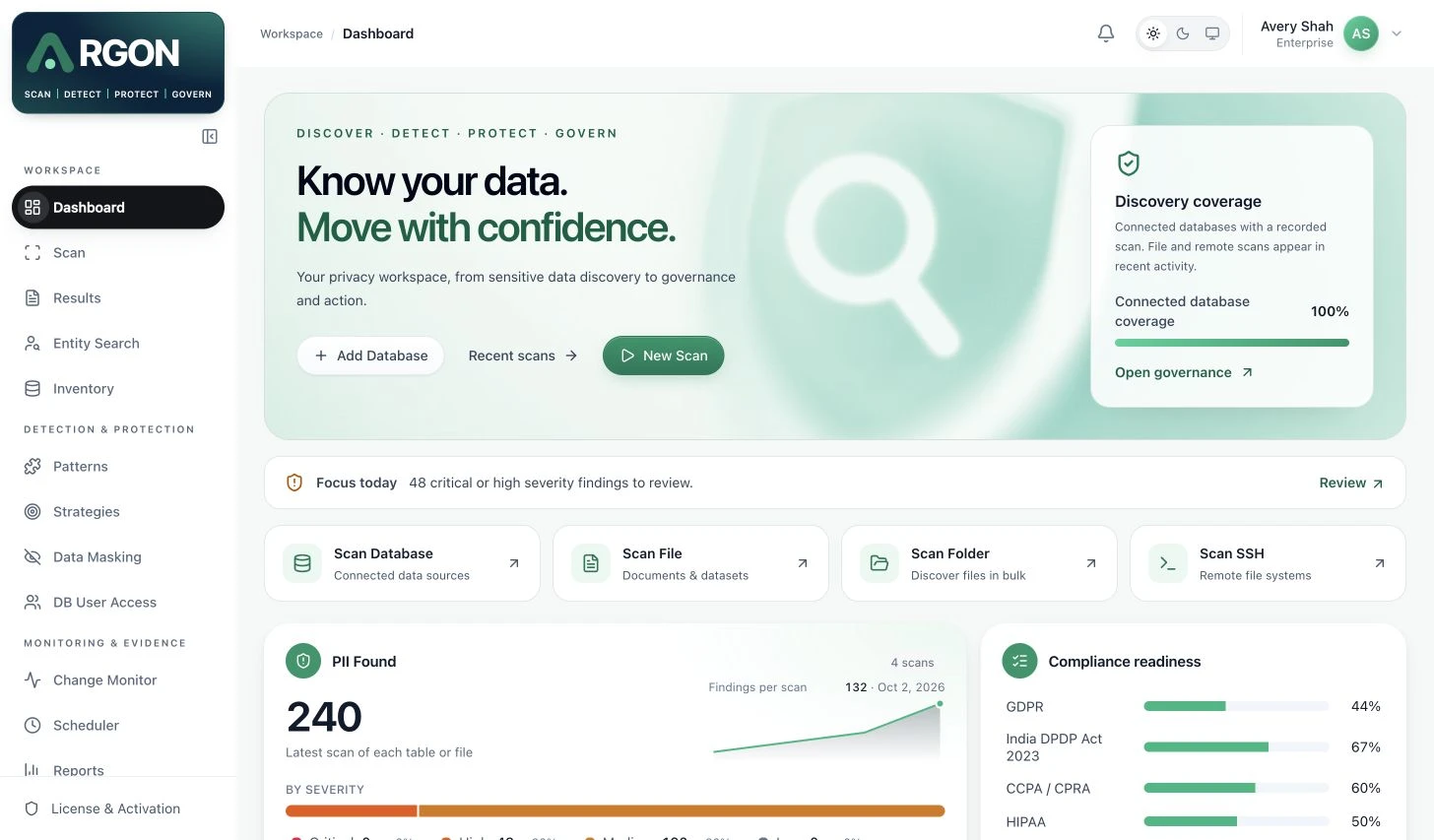
Configured sources, scan activity, sensitive-data findings and governance readiness. A working overview that helps your team decide what needs attention next.
Patterns identify candidates. Context analysis can help evaluate them. Your team gets source-level detail to investigate the findings.
Keep the same implementation phases while the controls, terminology and options change with the regulation you choose.
Connect processing purposes, departments, systems and retention to the sensitive data your organisation handles.
Assets, scan activity, PII counts, compliance posture and licence state on a single operating screen.
Add enterprise RDBMS, warehouses, NoSQL and document sources, organised by data platform.
Launch focused scans with the target count, scan mode and pattern coverage visible up front.
Pick the detection mode and the pattern sets in the same workbench as the source scope. Mode availability depends on the runtime and source.
Scan history, completion status, finding counts, severity and source context in one explorer.
Affected databases, tables, confidence and identifier categories, ready for remediation planning.
Grouped findings showing masked values, severity, confidence, affected columns and rows impacted.
Severity breakdowns, PII distribution and database coverage across completed scans.
Discovery, classification and governance. On your infrastructure.
Sensitive data spreads across legacy systems and modern cloud databases faster than any team can track it. A scanner limited to one environment — or one that requires moving data to work — leaves exactly the gaps that matter. Effective discovery has to be database-agnostic and give one view across the whole estate.
A single pane of glass over structured databases and unstructured file systems — so risk can be assessed across the whole organisation without migrating data or running a different tool per environment.
Deep interrogation of schemas, tables and records.
Document and managed database services.
Unstructured stores where KYC packs and contracts accumulate.
Bucket and blob storage across providers.
All 55 connector types from Argon: databases, warehouses, messaging, storage and cloud drives.

PostgreSQL
Enterprise RDBMS

MySQL
Enterprise RDBMS

MariaDB
Enterprise RDBMS

TiDB
Enterprise RDBMS

SQL Server
Enterprise RDBMS

Oracle
Enterprise RDBMS

IBM Db2
Enterprise RDBMS

SAP HANA
Enterprise RDBMS

SQLite
Enterprise RDBMS

Firebird
Enterprise RDBMS

CockroachDB
Distributed SQL

YugabyteDB
Distributed SQL

Greenplum
Distributed SQL

SingleStore
Distributed SQL

Snowflake
Cloud Data Warehouses

BigQuery
Cloud Data Warehouses

Amazon Redshift
Cloud Data Warehouses

Databricks
Cloud Data Warehouses

Aurora MySQL
AWS Managed

Aurora PostgreSQL
AWS Managed

Amazon DynamoDB
AWS Managed

Amazon DocumentDB
AWS Managed

Amazon ElastiCache
AWS Managed

MongoDB
NoSQL & Wide-column

Apache Cassandra
NoSQL & Wide-column

ScyllaDB
NoSQL & Wide-column

Apache HBase
NoSQL & Wide-column

CouchDB
NoSQL & Wide-column

Couchbase
NoSQL & Wide-column

Riak
NoSQL & Wide-column

Redis
Key-Value & Cache

Memcached
Key-Value & Cache

etcd
Key-Value & Cache

Aerospike
Key-Value & Cache

Elasticsearch
Search Engines

OpenSearch
Search Engines

Typesense
Search Engines

Meilisearch
Search Engines

ClickHouse
Analytics & Time-series

InfluxDB
Analytics & Time-series

Apache Kafka
Streaming & Middleware

RabbitMQ
Streaming & Middleware

Apache ActiveMQ
Streaming & Middleware

IBM MQ
Streaming & Middleware

TIBCO EMS
Streaming & Middleware

SAP Process Integration
Integration & ESB

MuleSoft
Integration & ESB

Qdrant
Vector Databases

Milvus
Vector Databases

Pinecone
Vector Databases

Amazon S3
Object Storage

Google Cloud Storage
Object Storage

Azure Blob Storage
Object Storage

Google Drive
Cloud Drives


OneDrive & SharePoint
Cloud Drives
Connector availability, drivers, permissions and authentication depend on your deployment. Vendor marks identify the connected products; SAP and IBM products use their vendor marks.
Scanning on regular expressions alone produces either a flood of false positives or quiet misses on obfuscated data. Argon pairs a large pattern library with an NLP layer that evaluates what surrounds a value before calling it sensitive.
Mode availability depends on your source and runtime. Server database scans use Regex; supported file, folder and SSH workflows can use AI analysis. Desktop database AI uses an eligible configured provider.
Pattern-based detection of known formats
Over 2,000 built-in patterns covering global financial identifiers, healthcare records and regional PII. Fast, broad first-pass coverage across a whole source.
Context-based identification
A locally hosted language model reads the surrounding context to judge whether a value is genuinely sensitive — the verification tier that pattern matching cannot provide.
Pattern and context together
Patterns find candidates at speed, the model confirms them in context. This is the mode most teams run for a balance of coverage and precision.
payments.cards · card_number
4242 4242 4242 4242PAN· Restricted · 0.94Regex flags the value as a candidate payment card. The model then reads the column name, the neighbouring fields and the surrounding records to decide whether this is a stored card number or a test fixture, a reference code, or padding.
Pattern only
Every 16-digit string is reported. The analyst triages the noise.
Hybrid
Context decides. Fewer findings to review, each with a confidence score.
With a local model configured, NLP inference happens on compute you allocate, on your own network, without sending scan data to an external AI service. Optional remote providers require explicit configuration and data-egress confirmation. Choose local inference when data must remain inside your perimeter.
Two scan modes for two different questions. Quick scanning answers “is there personal data here at all?” in minimal time. Full scanning answers “how much, of what kind, and where exactly?”
Capability
Quick / Incremental
Screening scan
Full / Detail
Measurement scan
Primary objective
Initial processing
Scan termination
Output
Processing effort
Typical use case
PII coverage
Quick scanning evaluates up to 10,000 records from the selected source. If nothing is found it continues incrementally through subsequent records until PII is identified, then stops and reports.
Argon replaces fragmented, manual privacy processes with a single automated path — four steps your team runs, inside your own network, ending in something your team can review and prepare for an audit.
Point Argon at a database or file repository using read-only credentials over your internal network or VPC peering.
The engine interrogates schemas, tables and files to locate candidate personal data across the selected sources.
Findings are categorised by identifier type, sensitivity and the regulations that apply to them.
You get a report with the affected tables and columns, masked sample values, confidence and rows impacted.
Eight capabilities that take you from not knowing where personal data is, to having a monitored, governed and evidenced position on it.
Scan databases and storage environments to identify and classify personally identifiable information automatically.
Configure recurring scans so discovery stays current as data changes, rather than a one-off snapshot.
Protect sensitive values through masking and controlled exposure to reduce unauthorised access and leakage.
Watch environments for changes, newly discovered sensitive data and emerging compliance risk, in real time.
Centralised classification, ownership and policy controls to give the business visibility over its sensitive data.
Analyse user privileges, permissions and access patterns to support least-privilege on the data that matters.
Map findings to the obligations that apply, across GDPR, the DPDP Act, CCPA/CPRA, POPIA, PCI DSS and LGPD.
A unified picture of sensitive data, exposure, access risk and compliance posture across the estate.
Discovery is only useful if it answers a specific obligation. Argon maps what it finds to the articles, sections and requirements your privacy and legal teams are actually working against.
Clause
What Argon can support
Art. 5 — Principles
Discover PII, classify data, identify excessive or unnecessary data.
Art. 6 — Lawfulness
Identify data categories requiring processing-purpose and lawful-basis mapping.
Art. 9 — Special categories
Identify sensitive and special-category personal data.
Art. 25 — Protection by design
Support data discovery, minimisation and protection visibility.
Art. 30 — Records of processing
Support data inventory and processing-data mapping.
Art. 32 — Security of processing
Identify sensitive data exposure and support protection controls.
Art. 35 — DPIA
Support identification and assessment of high-risk personal-data processing.
Argon supports compliance activities through discovery, classification, risk assessment, regulatory mapping and evidence generation. It does not by itself guarantee regulatory compliance. Exact applicability depends on your jurisdiction, processing activities, data categories, contractual obligations and scope, and should be validated by your privacy, legal or compliance function.
Argon installs into your environment rather than pulling data into someone else’s. Below is what the platform needs, so your infrastructure team can size it before the first conversation rather than after.
Application and scanner deployed inside the corporate network, on hardware you control.
Deployed within your own private cloud or VPC environment, reachable over internal networking.
No public internet access required when the native AI model is used — suitable for isolated environments.
Component
Basic
Recommended
Deployment
On-premises / private cloud / VPC
Private network
Server
12 vCPU
24 vCPU
RAM
32 GB
128 GB
Storage
250 GB
1 TB + SSD
Operating system
RHEL 9.x / Ubuntu 22.04+
Latest supported enterprise OS
Network
1 Gbps
10 Gbps
IP address
Static IP recommended
Static IP
Hostname
Dedicated hostname
Dedicated hostname
DNS
Internal DNS resolution
Corporate DNS
Internet
Not required for local AI deployment
No public internet access
Connectivity
Network access to the target database and file repositories over VPC peering or a secure internal gateway.
Authentication
Read-only database credentials for the discovery engine. Read/write only where the masking vault is integrated.
Compute
Local compute allocated for LLM inference, so NLP parsing runs without data leaving the perimeter.
Configuration
Scanning depth (sampling vs full-table) and the relevant pattern sets — GDPR, HIPAA, PCI DSS and others.
Actual sizing varies with data volume, number of sources, scan frequency, concurrent scans, file size and the AI model in use.
Netrik is a data security and privacy company specialising in PII scanning, data discovery and information risk management. Our mission is to make discovery and protection simple, accurate and actionable — without disrupting how the business runs.
Assessments and compliance consulting are delivered by certified practitioners. Every engagement is led by consultants holding globally recognised certifications, with hands-on experience across offensive security, governance, risk and compliance.
 OSCPOffSecOffensive Security Certified Professional
 CEHEC-CouncilCertified Ethical Hacker
 CISMISACACertified Information Security Manager
 CISSP(ISC)²Certified Information Systems Security ProfessionalCISAISACACertified Information Systems AuditorCRISCISACACertified in Risk and Information Systems Control
Control design, security architecture review and remediation planning for regulated environments.
Discovery, classification, ownership and retention control over personal data at scale.
DPDP Act, GDPR, ISO 27001, SOC 2, HIPAA and PCI DSS readiness and evidence generation.
Risk assessment, internal audit and third-party assurance across the supplier estate.
What security and compliance teams ask before a deployment. If something is not covered here, ask us directly.
Either on-premises, with the application and scanner inside your corporate network, or in a private cloud or VPC environment you control. Both are supported.
Relational databases including MySQL, PostgreSQL and Microsoft SQL Server, plus Oracle and NoSQL databases; file servers and NAS; network shares; cloud databases; and object storage.
Three approaches. Regex does pattern-based detection of known formats. LLM does context-based identification of sensitive information. Hybrid combines both for improved coverage — pattern matching finds candidates, context analysis confirms them.
No. The scanning architecture uses read-only access to the data source. The scanner analyses data without requiring write access to the source database or repository.
With a native or local AI deployment, scanning and AI-based classification occur within your controlled environment, without sending scan data to an external AI service. Optional external providers require explicit configuration and data-egress confirmation. Your selected deployment and provider determine where inference runs.
No. Customer scan data is not used to train, fine-tune or improve the underlying AI model unless explicitly authorised under the applicable agreement and product configuration.
Yes. Complete separation is maintained between customers, with no cross-customer data sharing or retention. With a local deployment, we do not have access to your data at all.
Yes. Argon supports compliance activities by mapping discovered and classified PII to applicable requirements under GDPR, the India DPDP Act, CCPA/CPRA, POPIA, PCI DSS and LGPD. It supports those activities; it does not by itself guarantee compliance.
Technical support covers product installation, configuration, connectivity, scanning and troubleshooting, according to your support plan.
Through the designated support email, the support portal, or another approved channel agreed during onboarding. A ticket reference is generated so the request can be tracked.
The most useful version of this conversation is the one run against a representative sample of your data, not a generic demo dataset.
01Talk to a solutions engineer
We come back within one business day to understand your environment and priorities.
02A walkthrough on your data
A 30–45 minute demonstration scoped to a representative sample of your estate.
03Findings you can take upstairs
A summary of key risks, affected systems and the regulatory obligations they touch.